
MFLOW Trading Guide: New Business, Old Business, And Participation Quality
Price can move for two very different reasons.
It can move because new participants are entering with conviction. Or it can move because old participants are exiting under pressure.
On a normal chart, both can look the same. A candle rises. Volume appears. The index moves higher. But the meaning of that move changes completely depending on what kind of participation is behind it.
If NIFTY rallies because fresh buyers are building new positions, the move has a different quality. It may continue, build value, and invite follow-through. If NIFTY rallies because shorts are covering old positions, the move may still be sharp, but it may not carry the same forward intent. Once the covering is done, the auction can stall.
MFLOW exists to separate these two conditions. On the chart it is a histogram. Each bar has a colour, a fill, and a height, and every bar starts at the zero line.
On Vtrender Charts, MFLOW helps traders read participation quality. It sits below the top-four Vtrender pillars. Market Profile gives location. Gamma and NTM VolX give options pressure. Order Flow gives execution confirmation. MFLOW then asks whether the participation behind the move is fresh business or old business.
That makes MFLOW especially useful for NSE derivatives traders. Index markets often move on unwind, covering, expiry adjustment, or forced positioning. A trader who treats every rally as conviction buying or every fall as conviction selling can misread the session. MFLOW adds a cleaner question: is this move being built, or is it being closed?
How To Read Each MFLOW Bar
Read the bar in front of you. Colour, fill, and height answer three different questions.
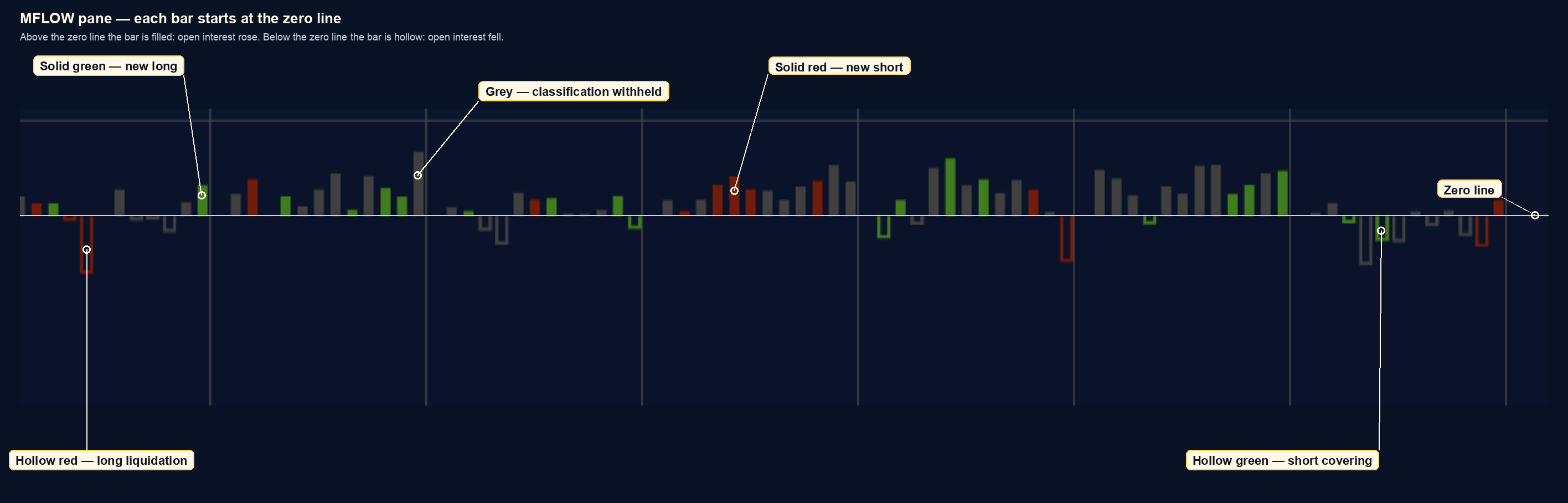
Colour is the side. Green is the long side: COT is not negative, which the chart describes as money coming in. Red is the short side: COT is negative, which the chart describes as money leaving or booking out. If COT is missing, the chart uses the sign of the open-interest change for the colour.
Fill identifies opening versus closing activity: solid means opening, hollow means closing. Grey means the directional classification was withheld. On the chart, a solid bar is filled in above the zero line when open interest rose enough to classify. A hollow bar is an outline below the zero line when open interest fell enough to classify.
| Bar appearance | Meaning |
|---|---|
| Solid green | New long business |
| Solid red | New short business |
| Hollow green | Short covering: existing shorts closing |
| Hollow red | Long liquidation: existing longs closing |
| Grey | Directional classification withheld (candle direction disagrees with COT, so the bar is not coloured green or red) |
The same five appearances are described in Understanding MFlow 2.0. The four coloured rows match the current chart. Grey is withheld direction, not old business. Old business is hollow green and hollow red only.
Flow that does not clear the open-interest threshold is not painted. A gap in the histogram is not a grey bar.
What height, positive values, negative values, and the zero line mean
These come from how the histogram is drawn, not from the colour.
Each bar is the change in open interest on that bar, divided by the volume traded on that bar. The pane fits those values to the visible range and adds a little padding, so height is comparative inside the window. A taller bar is a larger open-interest change relative to that bar's volume. It is not a fixed number of contracts, and it is not "more green" or "more red".
A positive value is drawn above the zero line. Open interest increased. When that increase is large enough to classify, the bar is solid.
A negative value is drawn below the zero line. Open interest decreased. When that decrease is large enough to classify, the bar is hollow.
The zero line is the origin. Every bar grows from zero out to its value. Positive and negative are the two sides of that line. Colour does not tell you which side you are on. A green bar below zero is hollow green: shorts covering, not new longs.
What MFLOW Measures: Beyond Generic Flow
Most traders are trained to look for activity. If volume rises, they assume something important is happening. If a candle expands, they assume the move has strength. If a generic flow chart shows aggressive activity, they may assume conviction.
MFLOW goes one layer deeper. It does not only ask whether activity exists. It asks what kind of activity exists.
That difference matters because every transaction has two sides, but not every transaction has the same intent. Some trades open new risk. Some trades close old risk. Some trades defend an existing position. Some trades are forced by movement. Some trades are fresh decisions.
Generic flow can show that activity occurred. MFLOW tries to classify the quality of that activity.
This is why MFLOW is not a replacement for Order Flow. Order Flow shows execution at price: who acted, whether aggression appeared, whether it was absorbed, and whether it produced follow-through. MFLOW adds participation quality: is the move supported by new business or old business?
For example, if price breaks above the Initial Balance and Order Flow shows Initiative Buying, the trader still wants to know whether the broader participation is fresh. Solid green bars are new longs and give the break better quality. Hollow green bars are short covering, and the breakout may be more vulnerable to failure.
MFLOW is therefore not a signal. It is a filter for the quality of a move.
New Business Versus Old Business: The Core Distinction
New business is forward-looking participation. It reflects traders opening positions because they expect the auction to continue in that direction or because they are actively building exposure.
Old business is backward-looking participation. It reflects traders closing, covering, rolling, or unwinding positions that already exist.
The difference can be subtle on a chart, but it is important on the desk.
A move driven by new business often has better continuation potential. It can build value, hold pullbacks, and create fresh references. A move driven by old business can travel quickly but fail once the unwind is complete.
This is most visible in short-covering rallies. Price rises sharply. Traders watching candles see strength. But the real driver may be sellers exiting, not buyers building. Once the trapped shorts are done covering, the rally may stop attracting fresh demand.
The reverse can happen in call-unwind falls or long-liquidation moves. Price falls quickly, but the movement may come from existing longs exiting or call-side positions unwinding rather than fresh directional selling. The fall can still matter, but the trader should not confuse liquidation with clean initiative selling.
MFLOW shows this distinction in the fill of the bar. Solid bars are new business. Hollow bars are old business. The Glossary carries the same terms: new business, old business, unwind, short covering, long liquidation, COT, VPOC, Value Area, gamma flip zone, and VXR.
How MFLOW Is Calculated And What It Reads
MFLOW reads active participation and classifies it into new business and old business. The exact model belongs to Vtrender Charts, but the trading interpretation is straightforward: it separates fresh positioning from position closure.
The tool does not ask only whether price moved. It asks whether the move is attracting new participation or only forcing old participants to adjust.
This is useful because many intraday moves are mixed. A rally may begin with short covering, then attract new buying. A fall may begin with long liquidation, then attract fresh selling. A move may begin with new participation and later become only late unwind. MFLOW helps the trader observe these changes.
A solid bar says fresh positioning is entering: solid green for new longs, solid red for new shorts. A hollow bar says existing positions are being closed: hollow green for short covering, hollow red for long liquidation. Colour and fill together matter more than either one alone.
If price rises with solid green bars, the move has better quality. If price rises and the bars are hollow green, or solid green fails to appear at the new high, be more careful. Covering can lift price without fresh longs.
If price falls with solid red bars, the move may have fresh selling behind it. If price falls on hollow red bars, the move may be long liquidation rather than clean downside initiative.
The desk read is simple: price tells what happened; MFLOW helps tell what kind of participation caused it.
Reading The MFLOW Bars In Real Time
The first rule is to read MFLOW with location.
If price is moving inside the prior Market Profile Value Area, read the bars differently from a move breaking out of value. Inside value, hollow bars and grey bars may confirm rotation. Outside value, solid bars matter more because the auction is trying to build away from prior acceptance.
The second rule is to read colour and fill together. A run of solid bars has a different character from a run of hollow bars. A stretch of grey bars, or bars that stay short, means the histogram is not offering a clean classification. A hollow bar that spikes and then fades can mean the move loses energy once the covering or liquidation is done.
The third rule is to read change. MFLOW is most useful when the bars change near a reference. Do solid bars appear at VAH? Do hollow bars dominate near a CE wall? Does solid green fail to print at a new high? Does hollow green show covering into a Gamma wall?
The fourth rule is to read follow-through. A strong MFLOW read without price acceptance may fail. A weak MFLOW read during a breakout warns that the move may lack sponsorship.
For live use, pair MFLOW with Vtrender Charts, Order Flow, and replay. The live read gives context. Replay shows whether the MFLOW clue appeared before continuation or failure.
MFLOW Divergence: When Price Makes New Extremes But Flow Does Not Follow
MFLOW divergence appears when price makes a new extreme but the participation behind the move does not confirm it.
If NIFTY makes a new high but solid green bars do not make a corresponding push above the zero line, pause. The price has extended, but fresh longs may not be supporting the move. Hollow green bars on that advance are short covering, not clean buying.
If NIFTY makes a new low but solid red bars do not expand above the zero line, the fall may be hollow red long liquidation rather than fresh selling. The move can still continue, but watch for failure, especially near Market Profile references.
Divergence matters most at known locations. A divergence at prior VAH, VAL, POC, Initial Balance high or low, CE wall, PE wall, Gamma Density zone, or VXR pressure shift is stronger than a divergence in the middle of random movement.
MFLOW divergence should not be used alone. It should lead to observation. Does Order Flow show COT? Does price return into value? Does NTM VolX show sellers regaining control? Does Gamma suggest a pin or a failed squeeze? If the answer aligns, the divergence becomes more meaningful.
The practical use is not to predict a turn. It is to notice that price has moved but participation quality has not kept up.
Short-Covering Rallies Versus Conviction Buying On NIFTY
Short-covering rallies are common in index derivatives. Price rises because sellers who were previously short are forced to exit. The move can be fast, emotional, and visually strong. But it may not be the same as fresh buying.
Conviction buying is different. It is new business entering because participants want long exposure. It usually has better potential to build value, hold pullbacks, and attract continuation.
MFLOW helps separate these two.
In a short-covering rally, hollow green bars dominate. Price can rise sharply while solid green stays absent or short. Order Flow may show buying activity, but the participation is existing shorts closing, not fresh longs.
In conviction buying, solid green bars expand with price, above the zero line. Pullbacks may hold. Market Profile value may migrate higher. Order Flow may show Initiative Buying with follow-through. NTM VolX may show near-the-money pressure supporting the move. Gamma may allow acceleration rather than pinning.
For NIFTY traders, this distinction is critical after gap-down opens, failed downside extensions, expiry adjustments, and sharp reversals from prior value. A rally from a low is not always bullish sponsorship. Sometimes it is only trapped sellers exiting.
MFLOW gives the trader a way to ask the right question before joining late.
MFLOW 2.0 On Vtrender Charts
MFLOW 2.0 is the histogram in the middle pane. It does not add a separate signal, and it does not split the read across two plots. One bar carries the classification: solid or hollow, green or red or grey, growing from the zero line.
That is the clarity. A trader can see whether the move is being built or unwound on the same pane as price, without assembling the read from disconnected plots.
MFLOW sits in the same workflow as the rest of Vtrender Charts, beside Market Profile, Order Flow, Gamma, NTM VolX, and Spectrum, depending on the plan. It is not a standalone dashboard.
A trader watching a breakout can use Market Profile for the value break, Order Flow for execution, MFLOW for the bar colour and fill, and Gamma or NTM VolX for options pressure. That is a complete read. The histogram is the participation-quality part of it.
The histogram is especially useful for review. After the session, revisit the move and ask: did solid bars appear before continuation? Did hollow bars dominate before failure? Did the bars diverge before a reversal? Did the pane keep you out of a late chase?
The measure of MFLOW 2.0 is not how many signals it gives. It is how often it improves the quality of the decision.
Combining MFLOW With Market Profile Structure And Order Flow
MFLOW needs structure. Without structure, participation quality has no location.
Market Profile gives that location. It shows whether price is inside value, leaving value, returning to value, testing POC, extending from Initial Balance, or repairing unfinished structure. MFLOW then tells whether the participation at that location is fresh or old.
Order Flow gives execution confirmation. It shows whether initiative participants are acting at the location and whether their activity is winning. MFLOW then tells whether that participation quality supports the move.
The cleanest read happens when all three align.
If price breaks above VAH, Order Flow shows Initiative Buying and COT support, and MFLOW prints solid green bars, the move has better quality. If price breaks above VAH, Order Flow shows buying, but the MFLOW bars are hollow green, be more cautious. That is covering, not new longs.
If price breaks below VAL, Order Flow shows Initiative Selling, and MFLOW prints solid red bars, the move may have stronger selling sponsorship. If the fall is hollow red, it may be long liquidation that can exhaust.
This is why MFLOW belongs as a support pillar. It does not replace Market Profile or Order Flow. It helps judge whether their signals are backed by the right kind of participation.
NSE-Specific Patterns: Put-Unwind Rallies And Call-Unwind Falls
NSE index options often produce moves that look directional but are driven by unwind.
A put-unwind rally can occur when put-side positions are being closed. Price may rise because earlier downside pressure is being removed. On the chart, the rally can look strong. If the MFLOW bars are hollow green rather than solid green, question whether fresh longs are actually present.
A call-unwind fall can occur when call-side positions are being closed or adjusted. Price may fall because earlier upside exposure is being removed. The fall can look directional, but it may not be fresh selling.
These patterns are especially relevant around expiry, after sharp opening moves, and near major strikes. Read them with Spectrum, because Spectrum shows CE walls, PE walls, and OI change. If a wall is unwinding and MFLOW is printing hollow bars, the two reads agree.
For example, if NIFTY rallies while put OI is unwinding and MFLOW shows hollow green bars, the rally may be put unwind rather than fresh upside conviction. If the rally reaches VAH and Order Flow cannot continue, the move may fail.
If NIFTY falls while call OI is unwinding and MFLOW shows hollow red bars, the fall may be call unwind rather than clean selling. If price reaches VAL and responsive buying appears, the move may repair.
MFLOW helps prevent the trader from mislabelling unwind as conviction.
Combining MFLOW With Gamma, NTM VolX, And Spectrum
MFLOW reads participation quality. Gamma, NTM VolX, and Spectrum read options pressure from different angles.
Gamma shows whether options hedging is likely to dampen or amplify movement. If MFLOW shows solid bars and Gamma supports acceleration, the move has better pressure alignment. If the solid bars are short or absent and Gamma suggests pinning, the move may struggle.
NTM VolX shows whether near-the-money options sellers are controlling the current range or under pressure. If solid bars print while VXR expands, the move may be gaining pressure. If the bars are hollow while VXR remains controlled, the move may be only a repair inside range.
Spectrum shows CE walls, PE walls, OI change, and net OI. If a wall collapses and MFLOW shows solid bars in the direction of the break, the wall failure has better quality. If the wall collapses but the bars are hollow, watch for exhaustion.
Together, these tools keep the trader from reading one data point too loudly. MFLOW tells what kind of participation is present. The options tools tell whether the market structure around that participation can support continuation.
Practical Session Workflow
Begin with Market Profile. Mark prior Value Area, POC, Initial Balance, gaps, single prints, and unfinished references.
Open MFLOW on Vtrender Charts. Read the bars before price reaches a major reference: solid or hollow, green or red or grey, and which side of the zero line they occupy.
At the open, classify the movement. Is the market opening with solid bars, or with hollow bars from positions being closed? If price is moving sharply on hollow bars, do not assume conviction yet.
During the session, watch for divergence. If price makes a new high but solid green does not follow, mark the location. If price makes a new low but solid red is missing, slow down.
Confirm with Order Flow. Look for COT, Initiative Buying, Initiative Selling, VPOC, strength, absorption, and follow-through at the same location.
Check Gamma, NTM VolX, and Spectrum when the move is options-sensitive. Is Gamma Exposure amplifying? Is VXR expanding? Is a CE or PE wall holding or collapsing?
After the session, replay the move. Did the bars warn before a failed breakout? Did solid bars support the best continuation move? Did hollow bars dominate a sharp but temporary move? This review builds the eye.
Common Mistakes
The first mistake is treating MFLOW as a buy-sell signal. It is a participation-quality tool, not a trigger.
The second mistake is reading MFLOW without Market Profile. A solid bar at a random location matters less than a solid bar at VAH, VAL, POC, or an Initial Balance break.
The third mistake is confusing hollow bars with weakness. Short covering and long liquidation can move price sharply. The issue is not whether a hollow bar can move price. The issue is whether that move can continue once the closing is done.
The fourth mistake is ignoring Order Flow. MFLOW can show participation quality, but Order Flow shows whether the activity at price is actually winning.
The fifth mistake is ignoring options pressure. On expiry day, a solid-bar read behaves differently when Gamma, NTM VolX, and Spectrum are aligned versus when they are resisting the move.
The sixth mistake is reading grey as old business. Grey means the directional classification was withheld. Old business is hollow green or hollow red.
Next Steps
The first next step is to open MFLOW on Vtrender Charts beside Market Profile and Order Flow. Read participation quality only after location is clear.
The second step is the Vtrender Learning Pathway, which places MFLOW below the top-four pillars and shows why structure comes before flow interpretation.
The third step is the Glossary. Use it for new business, old business, unwind, short covering, long liquidation, Value Area, COT, VPOC, gamma flip zone, VXR, CE Wall, and PE Wall.
The fourth step is the E-Course, especially for traders who need the auction foundation before reading participation quality.
Continue the main pillar path with Market Profile, Order Flow, Gamma, NTM VolX, and Spectrum. MFLOW becomes most useful when these tools are already part of the workflow.
Continue the nine-tool sequence on the Vtrender Learning Pathway.
View Learning PathwayFrequently Asked Questions
What is MFLOW on Vtrender Charts?
MFLOW is the histogram on Vtrender Charts that separates new business from old business. Solid green is a new long, solid red is a new short, hollow green is short covering, and hollow red is long liquidation. Fill identifies opening versus closing activity: solid means opening, hollow means closing. Grey means the directional classification was withheld.
What is new business in MFLOW?
New business is a fresh position being opened. On the histogram it is a solid bar above the zero line: solid green for a new long, solid red for a new short.
What is old business in MFLOW?
Old business is an existing position being closed. On the histogram it is a hollow bar below the zero line: hollow green for short covering, hollow red for long liquidation. It can move price sharply, but it may not carry the same continuation quality as fresh business.
Do grey bars mean old business?
No. Old business is a hollow bar below the zero line: hollow green is short covering and hollow red is long liquidation. Grey means the directional classification was withheld because the candle direction disagrees with COT, so the bar is not coloured green or red. Flow that does not clear the open-interest threshold is not drawn, so a gap in the histogram is not a grey bar.
How is MFLOW different from Order Flow?
Order Flow shows execution at price: initiative, absorption, COT, VPOC, and follow-through. MFLOW shows participation quality: whether the move is driven by new business or old business.
Can MFLOW be used alone?
MFLOW should not be used alone. It is best read with Market Profile for location, Order Flow for execution confirmation, and Gamma, NTM VolX, or Spectrum for options pressure context.
Trademark note
Vtrender™, Decode the Markets With Vtrender™, Power Trading with MarketProfile and Orderflow™, Smart Candlesticks™, Vtrender Micro Balance™, MFLOW™, NTM VolX™, WCash™, Vtrender IB 30™, and Vtrender IS 30™ are used as Vtrender brand, learning, and tool marks within the Vtrender trading education and charting ecosystem.