
Love Vtrender Charts? Check out our new offer!
Since 3 August 2026, the closing price of F&O-linked stocks has been determined through the Closing Auction Session (CAS) rather than the earlier methodology based on the final 30-minute VWAP.
Most discussion has focused on the final print: where the auction closes relative to the market at 3:15 PM.
The first week shows that the change reaches further than the cash close. It affects expiry settlement directly and has already changed how very-short-dated options are priced before the auction begins.
These need to be read separately.
The first effect appears in the underlying stocks.
Continuous trading in CAS-eligible stocks ends at 3:15 PM. The closing auction then finds a single equilibrium price from the orders available in that session.
When closing demand is balanced, the auction can finish close to the reference price.
When demand is concentrated on one side and opposing liquidity is limited near the reference, the equilibrium has to move until sufficient quantity becomes available.
A glosssary link to demand ans supply measurements is at - https://vtrender.com/glossary
The first week produced both outcomes.
On 3 August, Nifty moved from roughly 24,574 at the end of continuous trading to an official close of 24,774.30. The close was subsequently confirmed as valid. Futures and options did not make a comparable adjustment. On a non-expiry day there was no immediate settlement requirement forcing derivatives to accept that closing print as the next executable fair value.
The following day gave a different observation. Nifty was down roughly 1.25% at 3:15 PM but finally closed only about 0.6% lower after CAS. The auction moved against the direction established during continuous trading.
By 5 August, constituent data made the flow clearer. HDFC Bank cleared 0.24% above its CAS reference, Bharti Airtel 0.99%, Infosys 0.56%, ICICI Bank 0.49%, Reliance 0.53% and Bajaj Finance 0.76%.
The later sessions were more balanced. On 7 August, the major constituents included both positive and negative auction changes: Reliance +0.27%, Bharti Airtel +0.21%, Kotak Bank +0.41% and L&T +0.40%, while HDFC Bank was -0.10%, Axis Bank -0.55%, Bajaj Finance -0.18% and SBI -0.15%. Nifty consequently showed little displacement at the close.
That matters for the interpretation.
The first week does not establish that CAS must produce an upward close. It shows that a one-sided closing basket can move the equilibrium materially when opposing liquidity is limited.
There is an operational asymmetry worth monitoring. Additional buy liquidity requires capital. Additional sell liquidity requires deliverable stock or an available borrowing arrangement. That does not prevent a two-sided auction, but it can make incremental sell supply less responsive when a large buy-at-close basket arrives.
The relevant measure is therefore not simply whether CAS finished higher or lower. It is the breadth of the constituent move, matched value, index-weighted contribution and the amount of opposing liquidity available around the reference price.
The second effect is mechanical.
For expiring index derivatives, the final settlement price is the closing price of the underlying index in the cash market. The option's last traded premium and the final futures price do not determine that settlement value. NSE's settlement methodology states this directly.
This became visible on the first Nifty expiry after CAS.
Nifty was around 24,465 before the auction and finished near 24,615. The 24,400 call moved from roughly ₹97 to around ₹217 as the settlement value moved towards the new cash close.
The option charts are avavailble at - https://charts.vtrender.com/
That response was different from the previous non-expiry session for a simple reason: the cash close now determined the value at which the expiring contract would settle.
The derivatives market remains open after the continuous cash session has ended. Traders can continue to transact, hedge or close positions. Those trades can change the price at which a position is entered or exited.
They cannot change the cash-index closing value once that closing value has been established.
This produces a new basis to watch into expiry: the relationship between the continuously traded derivative and a settlement benchmark being formed in a separate cash auction.
Thursday's Sensex expiry confirmed that the issue is not confined to Nifty. Sensex finished nearly 170 points above its 3:15 PM level, its largest closing movement in the first week of CAS.
The third effect begins before CAS itself starts.
By Thursday, the options market had already seen Tuesday's Nifty settlement. The possibility of another auction-driven settlement move now had a price.
At approximately 10:25 AM on the Sensex expiry, Vtrender's IV Split showed ATM implied volatility around 41 in the expiring series.
At almost the same time, with Sensex at approximately the same spot level, the following week's ATM IV was around 16.
The difference was concentrated in the contract that had to settle through that afternoon's CAS.
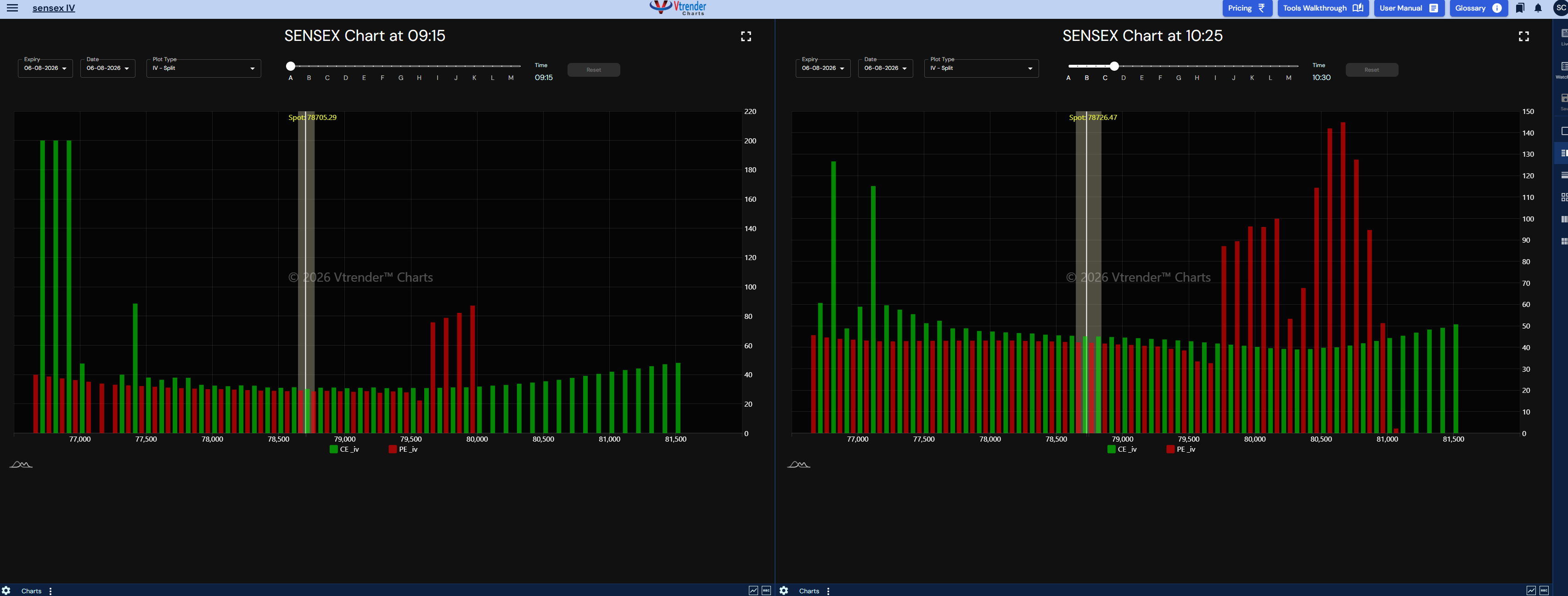
During the session, the front-expiry ATM IV moved from the low 40s towards approximately 60 around 1 PM and close to 96 near 3 PM on our screens. The following-week series remained around the mid-teens.
That does not mean the market progressively forecast 40%, 60% and then 96% annual Sensex volatility.
On 0DTE, annualised IV can rise simply because a relatively fixed amount of event risk remains while the time available to express that risk keeps shrinking.
A user manaul on how to trade settlement effectively is at - https://charts.vtrender.com/user-manual
The IV rise therefore does not have to represent an increase in the expected CAS move. It can represent the same unresolved settlement risk being compressed into less remaining time.
The next-week series provides the control.
A calm CAS is known only after the auction. At 1 PM the expiring option still has to price the possibility that it will not be calm.
The cash observation asks where the auction clears and how much constituent flow was required to get there.
The expiry observation asks what final cash-index value the derivative contract settles against.
The volatility observation asks what the market is charging beforehand for the uncertainty around that settlement.
The last one may have the most immediate effect on established expiry strategies.
A short straddle or strangle near expiry can no longer be read only as a theta trade against the remaining continuous session. Part of the premium can represent unresolved CAS settlement risk.
That changes the late-day decay profile.
It also creates a structural break in historical 0DTE data. An expiry strategy tested on observations before 3 August 2026 was operating under a different closing mechanism.
At Vtrender we are separating the data into three series: the constituent-level CAS displacement and matched value; the 3:15 PM index versus final settlement close on expiry; and the expiring-versus-next-expiry IV surface through the session.
The first week is too small a sample to establish a permanent directional CAS bias.
The derivatives effect is already easier to identify. The market is assigning a value to CAS uncertainty before the closing auction starts.
That premium can now be measured against the movement the auction eventually delivers.
Chart reference
The strike-by-strike IV Split is available on Vtrender Charts for registered users on the free plan:
Vtrender IV Split- link - https://charts.vtrender.com/bar-chart/NIFTY_Strike_IV
Vtrender™, NTM VolX™, MFLOW™, WCASH™, Smart Candlesticks™, Vtrender Micro Balance™, Vtrender IB 30™ and Vtrender IS 30™ are trademarks of Vtrender Technologies Private Limited. Trademark applications filed with the Trade Marks Registry, Mumbai

Markets don't move because indicators change.
Indicators change because markets move.
A practical reference for NSE & BSE derivatives traders. 366 pages, built to sit open beside live charts.