
Love Vtrender Charts? Check out our new offer!
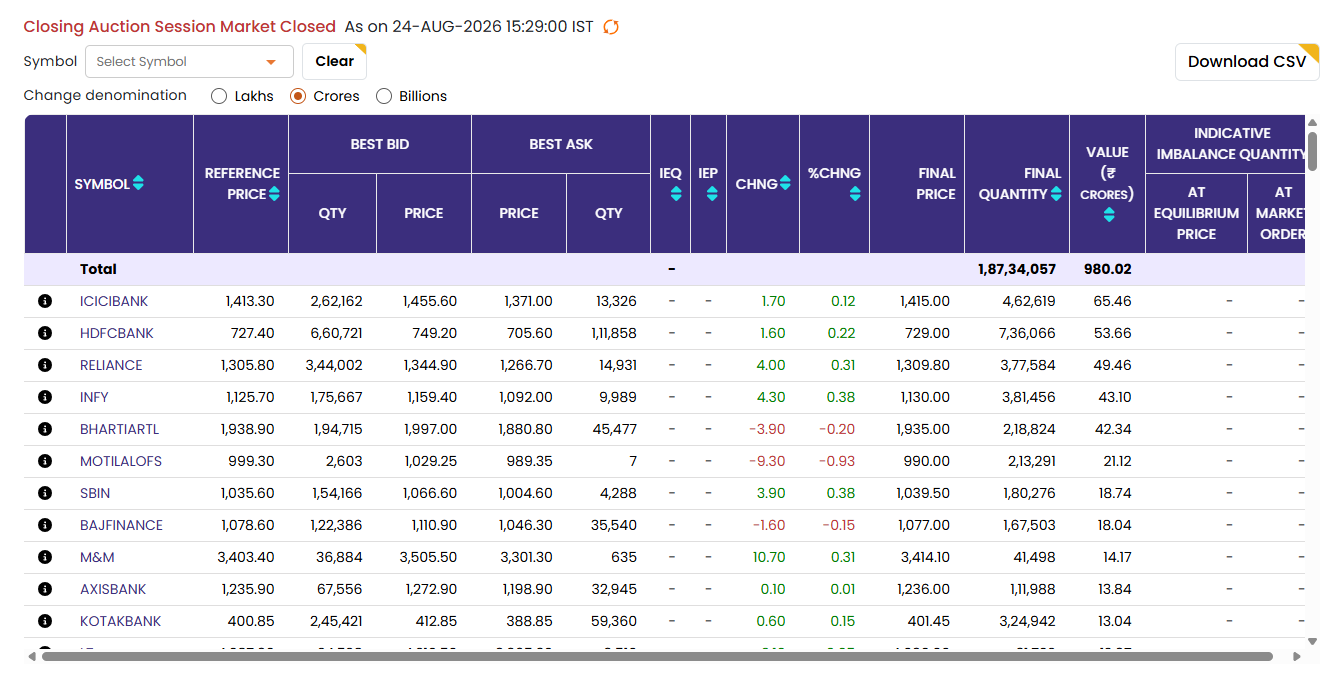
For trade date 24th Aug, a CAS scren read this
The NSE CAS auction can be tracked at - https://www.nseindia.com/market-data/closing-auction-session
The BSE at - https://beta.bseindia.com/markets/Equity/equitysensexstream.html?flag=c
Let's read the above screen left to right-
Reference Price
This is the VWAP of trades from 3:00 pm to 3:15 pm. If no trade occurs in that window, the day’s LTP is used; if there was no trade all day, the previous close is used.
Best Bid / Best Ask
These are the best visible limit prices in the auction book. CAS operates inside a ±3% price band around the reference price. Market orders are also allowed, but they do not themselves carry a price. Stop-loss and iceberg orders are not allowed.
So for RIL with reference ₹1,305.80, the legal auction-price envelope is roughly:
1305.80×0.97 ≈1266.63
to
1305.80×1.03 ≈1344.97
which is why displayed ask of ₹1,266.70 and bid of ₹1,344.90 sit almost exactly at the two edges.
We covered CAS and it's behavior at - https://vtrender.com/posts/closing-auction-session-cas-from-3-august-what-changes-at-the-close-cash-and-derivatives
Do read the pre CAS Outlook first
IEQ — Indicative Equilibrium Quantity
this is the quantity that would execute at the current equilibrium price if the auction were to close at that moment.
IEP — Indicative Equilibrium Price
this is the current theoretical clearing price, i.e. the price at which the maximum executable volume is available at that moment.
CHNG / %CHNG
these are the move in the eventual/final auction price relative to the reference price, not relative to the 3:15 LTP.
For RIL:
1309.80−1305.80=+4.00
and:
4/1305.80≈0.31%
which matches the screen.
Final Price
this is the actual CAS equilibrium price determined at auction close.
Final Quantity
This is the quantity actually matched/executed at the final auction price.
Indicative Imbalance Quantity
It is the residual unmatched buy or sell interest at the equilibrium price while the auction is still indicative. It tells you how much demand or supply remains unmatched after calculating the quantity that can cross at the IEP.
So conceptually:
Imbalance=∣cumulative eligible buys−cumulative eligible sells∣
at the equilibrium price.
It is therefore an auction-state indicator before the uncross, rather than simply “whatever remained unfilled after the completed auction.”
Time | What happens |
|---|---|
3:00–3:15 | Normal continuous trading. VWAP here becomes CAS reference price. |
3:15–3:20 | Transition/reference-price calculation. No CAS order entry yet under the original framework. |
3:20–3:25 | CAS order entry: limit + market orders can be entered, modified and cancelled. |
3:25–random close | Only limit-order entry/modification/cancellation allowed. No new market orders; existing market orders cannot be modified/cancelled. |
3:28–3:30 | Auction order-entry period closes at a random system-generated time. |
Immediately after random close–3:35 | Order matching and trade confirmation. |
3:35–3:40 | Cash CAS is finished; equity derivatives are still trading. |
3:40 | Equity derivatives close. |
3:35–3:50 | Cash market transition to post-close session. |
3:50–4:00 | Post-close cash session at the established closing price. |
Market orders do not run all the way to 3:30.
They are allowed only during:
3:20–3:25
During:
3:25–random close between 3:28 and 3:30
only limit orders can be entered/changed/cancelled. Market-order entry/modification/cancellation is not allowed.
And the auction itself does not necessarily stop at exactly 3:30. The order-entry window closes randomly sometime between 3:28 and 3:30, after which matching begins.
READ- https://vtrender.com/posts/closing-auction-session-cas-the-cash-close-is-only-part-of-the-change
This is the actual uncross / matching and confirmation phase.
At that point the exchange has already determined the equilibrium price using the auction book. The matching engine then allocates executions according to the prescribed priority:
market orders against market orders, time priority
residual market orders against limit orders
remaining limit orders against limit orders, price-time priority.
The key point: no more price discovery from new orders once random closure has occurred. The book is locked and the matching/confirmation process is happening.
This is the structural part worth highlighting.
By around 3:35, the cash auction close has been established.
But equity derivatives continue until 3:40.
So on expiry day you effectively get:
cash settlement reference known → derivatives market still open for ~5 minutes
That is important for options because participants can still react to the now-known cash close before derivatives shut.
This is another reason your term Expiry CAS has substance. On ordinary CAS, the auction is principally discovering a cash close. On expiry CAS, that discovered price has an immediate derivative-settlement consequence while the derivative market itself remains open briefly afterward.
3:00–3:15 → build reference price
3:15–3:20 → transition
3:20–3:25 → market + limit orders
3:25–3:28/30 → limit orders only
3:28–3:30 random close → auction freezes
up to 3:35 → matching/confirmation
3:35–3:40 → derivatives alone still trade
3:40 → derivatives close
3:50–4:00 → post-close cash session
For more articles and interviews with MINT, CNBC, NDTV and Others do check our newsroom - https://vtrender.com/newsroom
Markets don't move because indicators change.
Indicators change because markets move.
A practical reference for NSE & BSE derivatives traders. 366 pages, built to sit open beside live charts.