
Love Vtrender Charts? Check out our new offer!
Order Flow analysis is the study of traded activity inside price movement.
It begins with a simple idea: price is the output, not the process. A candle shows the result of buying and selling. Order Flow shows the negotiation that produced that result.
This post is the advanced companion to the Order Flow pillar page. Read the pillar for the complete framework, and use this post to move from beginner footprint reading to intent-based auction analysis.
Terms used in this note: Initiative Buying, Initiative Selling, Absorption, COT, Auction Intent.
I. The Foundation: What is Order Flow?
Order Flow Trading is a specialized methodology employed by traders to analyze the underlying supply and demand dynamics of the market. Unlike traditional charting methods that focus solely on price action, Order Flow aims to provide a deep dive into the actual transactions that drive market movements.
Defining Order Flow
Reading Demand and Supply: Orderflow simply means reading the demand and supply side of the market.
Tracking Transactions: The methodology involves tracking the volume and price movements of individual trades to gain critical insights into market sentiment.
Real-Time Data: Because Orderflow is read live and based on current actual traded volumes of the market, the tools used are known as Orderflow charts. These charts replicate the transactions taking place at the moment.
Specialized Tools: Traders utilize specialized order flow tools to conduct this analysis. These OrderFlow charts are considered an essential tool for any trader’s arsenal.
Go for a deeper introduction at - https://vtrender.com/posts/what-is-exactly-the-orderflow
II. Looking Inside the Market Bar: Why Order Flow Matters
Understanding Order Flow allows traders to see beyond the limitations of traditional price charts, offering a superior edge in anticipating market action. Most charts will have an Open, High, Low and close of your chosen time frame from 1 minute to 1 hour to 1 day or 1 week/month/year and add a volume number below that bar which is a consolidated figure
The Orderflow chart breaks the same 1 minute chart into Bid Traded Volume and Ask traded Volume allowing you to see who and what moved prices from Open to close or from Highs to the lows of that bar.
Seeing Beyond Price Action
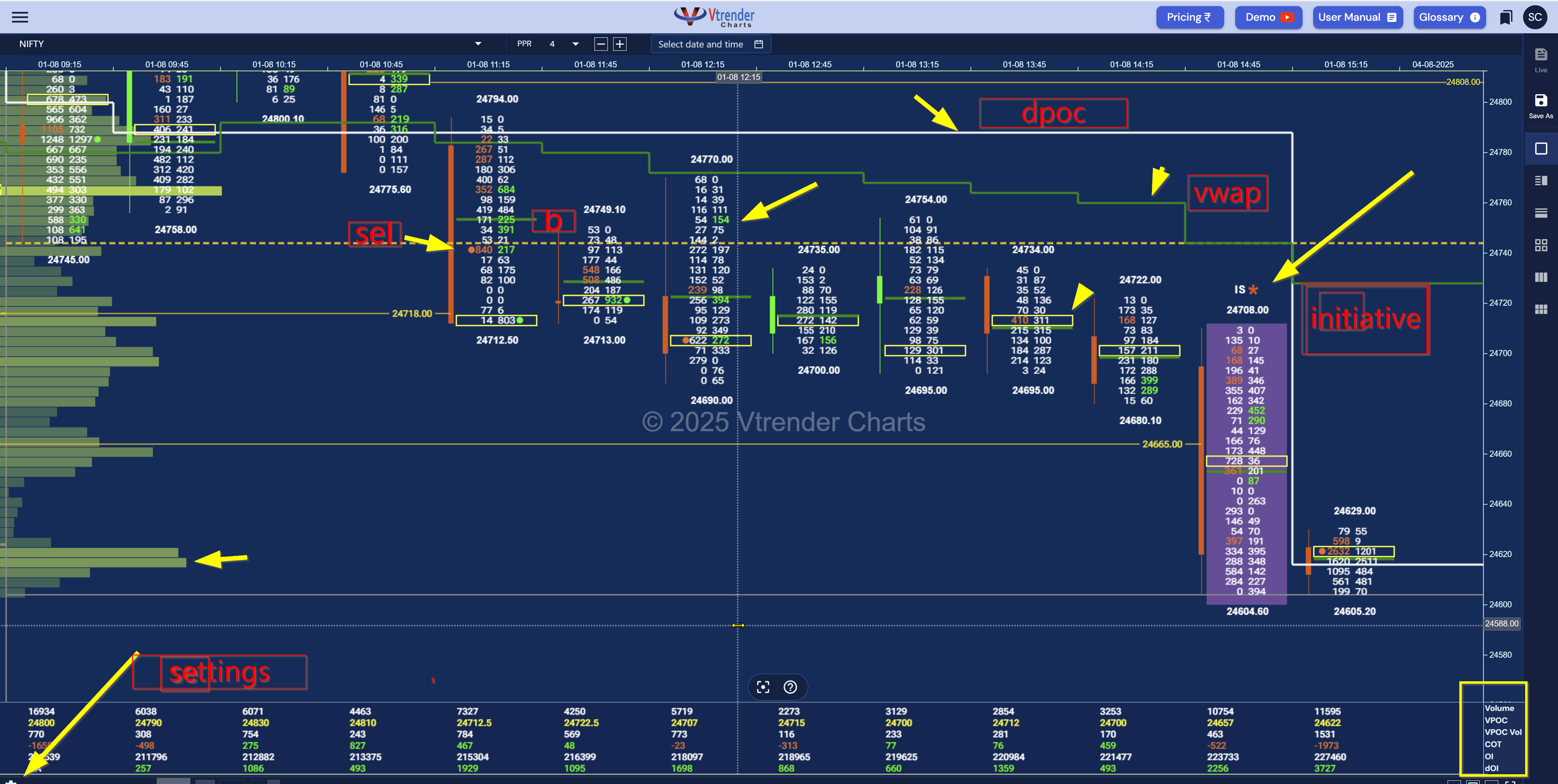
Traditional trading tools generally reflect only the outcomes of market actions. In contrast, Order Flow offers a direct view into the real transactions and intentions of market participants.
The main advantages of using Order Flow include:
Understanding Commitment: Order flow analysis allows traders to understand the real-time buyer vs seller commitment that is driving market movements.
Identifying Institutional Intent: Order flow provides a means to discover how to read institutional intent in markets, such as the NSE derivatives markets.
Proactive Intelligence: By analyzing Order Flow, traders can transform from being reactive price-watchers to utilizing proactive market intelligence.
Finding the Market's Engine Room
A crucial distinction of Order Flow is that it answers the question of who is driving the price change and how aggressive they are.
Beyond What Happened: Most standard charting platforms show you what happened (the price movement).
Who Did It: Orderflow charts, such as those developed by Vtrender, show you who did it and how aggressive they were when executing their trades.
Stepping Inside: When looking at an Orderflow chart, a trader is effectively stepping into the engine room of the market.
This deep insight is particularly useful in an ever-evolving world of trading, providing a significant edge in understanding market movements, especially during volatile market conditions.
III. The Engine Room: Market Orders, COT, LLT, and Volume Dynamics
To fully utilize Order Flow, a beginner must grasp how different types of orders interact and how they influence price movement. This involves exploring real-world dynamics, specifically concerning large market orders and their relationship with the order book.
The Role of Market Orders
In the mechanics of Order Flow, it is essential to understand that market orders drive fast price moves. Market orders are executed immediately against available limit orders on the order book.
Footprints of Aggression: Order flow analysis provides a practical guide to understanding how market and limit orders interact in real-time. Initiative buyers and sellers leave observable footprints on your charts when they execute their aggressive market orders.
Calculating COT: A critical concept in this analysis is learning how COT is calculated. COT measures the difference between all demand and supply in the markets, providing a concrete measure of current pressure.
IV. Practical Application: Trading with Order Flow Charts
For traders who have embraced this methodology, Order Flow analysis often transitions from being a mere tool to becoming a fundamental approach to market participation.
System and Strategy
Vtrender, for instance, focuses on describing its system of trading, the larger theory behind it, and the ways to understand it to generate maximum profits for traders.
Focus Markets: For the community of traders working with Vtrender, particularly on the Nifty and the Bank Nifty futures and Options, Order Flow trading is described as a way of life for every session.
Revolutionise your trading results - https://vtrender.com/posts/revolutionize-your-trading-with-orderflow-charts
Trust and Reliability
The high degree of trust placed in Order Flow charts stems from their ability to decode market moves by revealing the truth behind market trends. By visualizing real-time buying and selling pressure, the charts allow traders to identify where sellers are aggressively selling the tape, even at specific price levels. This focus on "Trade the Truth" underscores the power derived from Order Flow analysis.
Order Flow is not a shortcut. It is a better way to observe the process behind price.
Read next: A Beginner's Guide to Reading Order Flow Charts, Why 12,000 Contracts Moved Price When 45,000 Could Not, and When the Wrapper Changes But the Intent Doesn't.
Next step: use the Vtrender Learning Pathway to connect Order Flow with Market Profile, MFLOW, Smart Candlesticks and the options tools.
To practice live, open Vtrender Charts.
Markets don't move because indicators change.
Indicators change because markets move.
A practical reference for NSE & BSE derivatives traders. 366 pages, built to sit open beside live charts.