
Love Vtrender Charts? Check out our new offer!
Size does not move price by itself. Size matters only when it appears at the right location, with the right intent, and then gets accepted by the market.
This is why 12,000 contracts can sometimes move price cleanly while 45,000 contracts do nothing. The larger number may be passive, absorbed, defensive, or located in the wrong part of the auction. The smaller number may arrive at a key level where the market is ready to change state.
Terms used in this note: Acceptance, Initiative Buying, Value Area, Point of Control, Absorption, COT, Delta.
The first question is not "how much traded?" The first question is "where did it trade?"
That is the role of Market Profile. Market Profile tells us whether the trade is happening inside value, outside value, near the Point of Control, near the Value Area edge, or in a zone the market has already rejected. A 45,000-contract print inside a well-established value area is noise. The same 45,000 at a single print from three sessions ago is a different read entirely.
The second question is "who acted?"
That is the role of Order Flow. Order Flow separates aggressive buying from aggressive selling and shows whether aggression actually moved price or got absorbed. A large number that cannot move price is often not strength — it may be trapped participation. COT turning negative on repeated tests at the same level is a separate data point from raw volume alone.
The third question is "did the market accept the move?"
A price move that trades above value and then holds is different from a price move that spikes and returns. Acceptance is where size becomes information. Rejection is where size becomes warning. The IB and IS signals on the Order Flow chart help mark the moment when one side sustained control long enough to matter.
One sequence from a recent session.
At 2:56 PM, a responsive print of 45,000 contracts appeared on a PE. Large by any measure. Price barely moved.
At 3:00 PM, an initiative print of 12,000 contracts appeared on the same option. Price moved from 150 to 217 in sixty seconds.
The smaller number did the work.
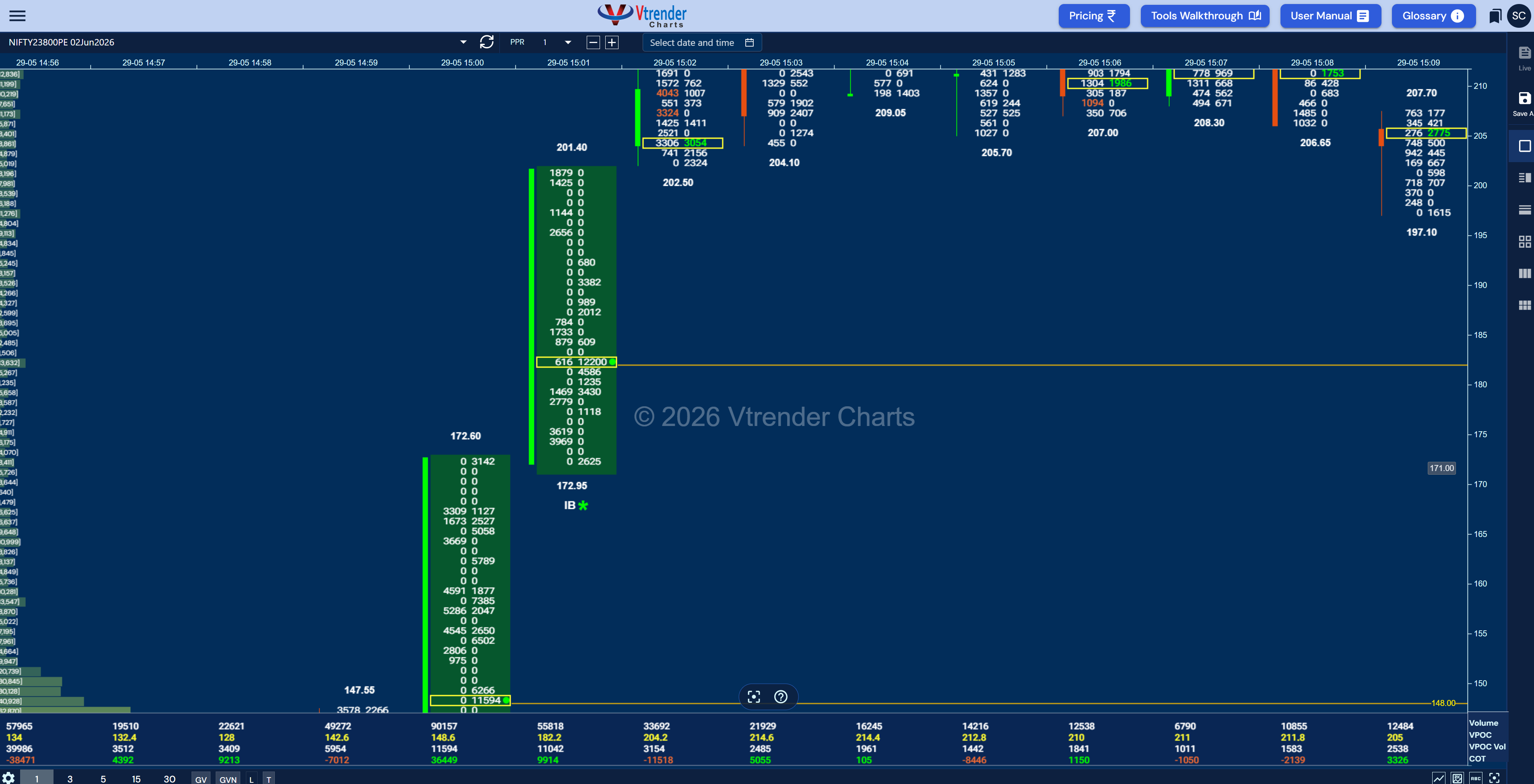
Reading the sequence.
The read runs in four parts:
Where did the activity appear — at a responsive zone, or breaking out of one.
What kind of activity was it — absorbing flow, or pressing into it.
Did price accept the activity — held the level, or rotated away.
Did follow-through arrive — in seconds, or never.
The 45,000-contract print sat at a responsive zone and was absorbed.
The 12,000-contract print arrived with intent and was followed through. Same instrument, four minutes apart, opposite outcome.
Size on its own is data. Size plus location plus intent plus acceptance is information.
The video below walks the sequence in real time.
https://x.com/i/status/2060673789894250943
MFLOW adds the participation layer. MFLOW asks whether a move is being driven by new business or old business. Fresh participation carries a different meaning from short covering, long liquidation, or defensive unwinding. A 12,000-contract move driven by new money reads differently from a 45,000-contract print that is entirely COT-rotation.
The Options Table adds the positioning layer. If the move happens near an options strike with strong OI, volume, VWAP, or DPOC activity, the same trade carries more weight — it is interacting with existing options positioning, not just moving through an empty price zone. This is where Gamma Density becomes relevant for understanding why certain levels repel or absorb price.
A Vtrender read of the same print:
Market Profile — locate the auction. Is the print inside value, at the edge, or in a prior rejection zone?
Order Flow — who acted at that location? Was there sustained aggression or absorption?
MFLOW — is the participation new or defensive?
Options Table — does options positioning at that strike support or resist the move?
The lesson: volume is not the signal. Volume at location, with intent, followed by acceptance, is the signal.
Related reading: When the Wrapper Changes But the Intent Doesn't — how execution method shifts without changing the underlying order flow read. Order Flow PLR — the responsive vs initiative distinction in practice. The Progressive Guide to Order Flow Analysis — a structured sequence from aggression to delta to acceptance.
To build this read from the beginning, the Vtrender Learning Pathway is the starting point. To see it on live Nifty and BankNifty charts, open Vtrender Charts.
Markets don't move because indicators change.
Indicators change because markets move.
A practical reference for NSE & BSE derivatives traders. 366 pages, built to sit open beside live charts.