
Love Vtrender Charts? Check out our new offer!
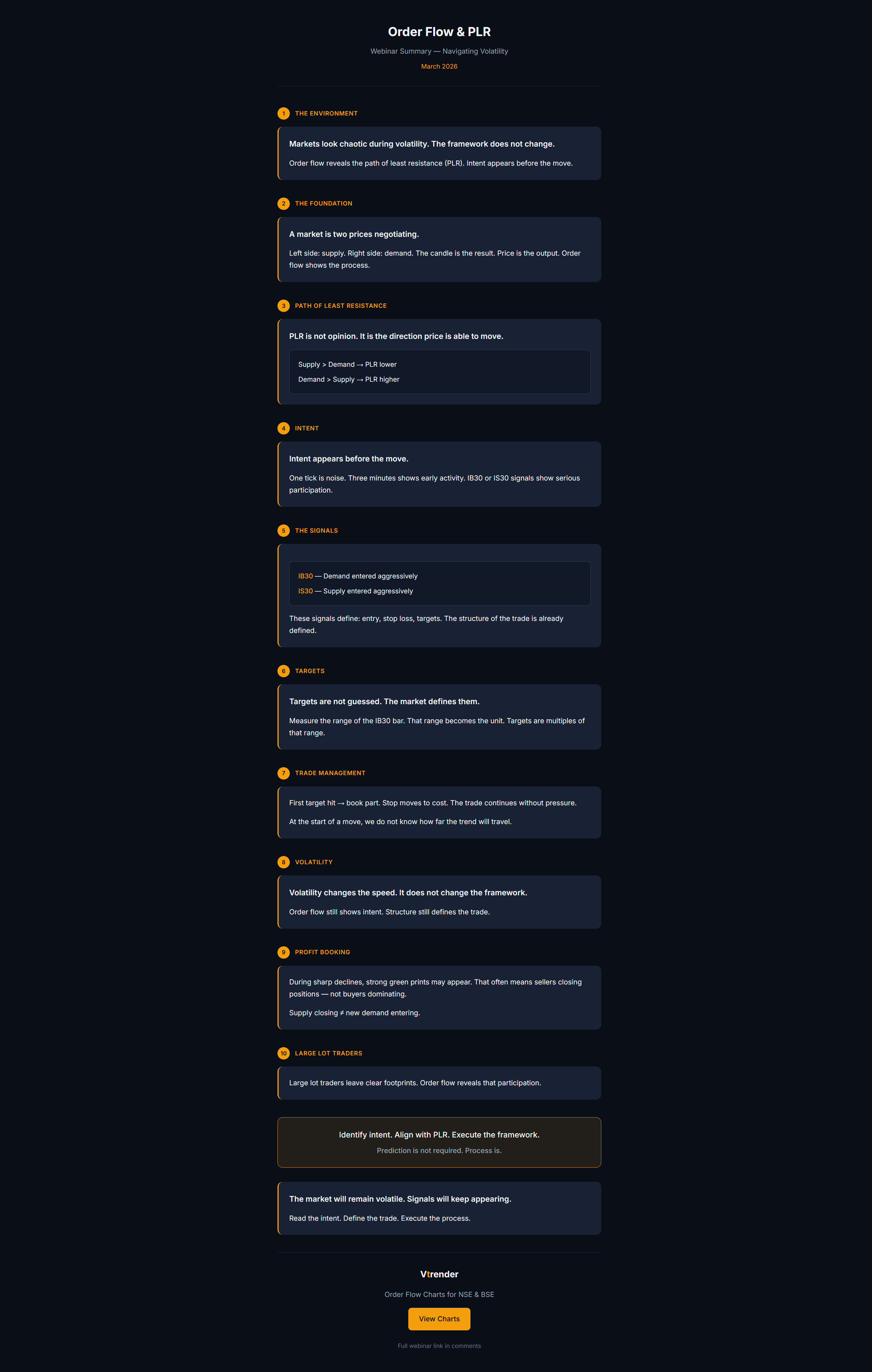
A market is always negotiating between two sides. One side is supply. The other is demand. The candle is only the result of that negotiation. Order Flow shows the process behind it.
Terms used in this note: Balance, Point of Control, Acceptance, Absorption, Value Area.
PLR means Path of Least Resistance — the direction in which the market can move with the least opposition. PLR is not found by guessing. It is read from where aggression appears, where it fails, and where the auction accepts price.
The first layer is structure.
Market Profile shows whether price is inside value, outside value, near the Point of Control, near Value Area High, near Value Area Low, or in a zone the market has rejected before. PLR reads differently inside value than outside it. Price rotating inside a balanced value area has resistance on both sides. Price accepted outside value has cleared resistance on one side already.
The second layer is aggression.
Order Flow shows who is acting. If buyers lift offers and price moves higher with acceptance, the path may be up. If buyers lift offers and price cannot move, the aggression may be absorbed — that is not a clean upside path. The same applies to sellers: selling that produces downside continuation is a different read from selling that gets trapped.
The third layer is participation.
MFLOW asks whether the activity is new business or old business. A move driven by fresh participation carries a different quality from a move driven by short covering or liquidation. Two moves in the same direction can have opposite PLR meaning depending on who is behind them.
Smart Candlesticks keep the candle view while adding inside-bar context. IB and IS bars, micro balance zones, and order-flow markers show whether the candle structure supports the PLR read or contradicts it.
A PLR read, layer by layer:
Market Profile — define the structure and where price sits within it.
Order Flow — read aggression at that location.
MFLOW — judge participation quality.
Smart Candlesticks — connect flow to bar structure.
The path of least resistance is clearest when price, intent, and acceptance point in the same direction. When they diverge, the auction has not yet resolved which side is meeting less resistance.
The path of least resistance is not a prediction. It is an observation — what remains visible when the market shows which side is meeting less resistance at the current location.
Related reading: Why 12,000 Contracts Moved Price When 45,000 Could Not — why location and acceptance decide whether size becomes PLR. When the Wrapper Changes But the Intent Doesn't — reading intent regardless of how the order arrived. The Progressive Guide to Order Flow Analysis — the full sequence from aggression to acceptance.
For the complete learning sequence, use the Vtrender Learning Pathway. For live practice on Nifty, BankNifty, Sensex, and Bankex, open Vtrender Charts.
Markets don't move because indicators change.
Indicators change because markets move.
A practical reference for NSE & BSE derivatives traders. 366 pages, built to sit open beside live charts.